 Synopsys Formality 培訓班 Synopsys Formality 培訓班 |
| 入學要求 |
|
學員學習本課程應具備下列基礎知識:
◆ 電路系統的基本概念。 |
|
班級規模及環境 |
|
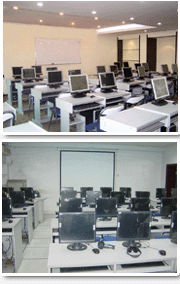
為了保證培訓效果,增加互動環節,我們堅持小班授課,每期報名人數限3到5人,多余人員安排到下一期進行。 |
|
上課時間和地點 |
上課地點:【上海】:同濟大學(滬西)/新城金郡商務樓(11號線白銀路站) 【深圳分部】:電影大廈(地鐵一號線大劇院站)/深圳大學成教院 【北京分部】:北京中山學院/福鑫大樓 【南京分部】:金港大廈(和燕路) 【武漢分部】:佳源大廈(高新二路) 【成都分部】:領館區1號(中和大道) 【沈陽分部】:沈陽理工大學/六宅臻品 【鄭州分部】:鄭州大學/錦華大廈 【石家莊分部】:河北科技大學/瑞景大廈
最近開課時間(周末班/連續班/晚班):Synopsys Formality 培訓班:2025年12月15日..以質量贏得尊重節假日班火熱報名中.....實戰培訓......直播、現場培訓皆可....用心服務..............--即將開課--(即將開課,請提前報名)... |
|
學時 |
◆課時: 共5天,30學時
◆外地學員:代理安排食宿(需提前預定)
☆注重質量
☆邊講邊練
☆合格學員免費推薦工作
☆合格學員免費頒發相關工程師等資格證書,提升您的職業資質
專注高端培訓15年,曙海提供的證書得到本行業的廣泛認可,學員的能力
得到大家的認同,受到用人單位的廣泛贊譽。
★實驗設備請點擊這兒查看★ |
|
最新優惠 |
|
◆團體報名優惠措施:兩人95折優惠,三人或三人以上9折優惠 。注意:在讀學生憑學生證,即使一個人也優惠500元。 |
|
質量保障 |
|
1、培訓過程中,如有部分內容理解不透或消化不好,可免費在以后培訓班中重聽;
2、培訓結束后免費提供半年的技術支持,充分保證培訓后出效果;
3、培訓合格學員可享受免費推薦就業機會。 ☆合格學員免費頒發相關工程師等資格證書,提升您的職業資質。專注高端培訓13年,曙海提供的證書得到本行業的廣泛認可,學員的能力得到大家的認同,受到用人單位的廣泛贊譽。 |
Synopsys 軟件培訓班(上)
|
| |
第一階段 Synopsys Formality |
| 本課程可幫助IC工程師進一步全面系統地理解IC設計概念與方法。培訓將采用Synopsys公司相關領域的培訓教材,培訓方式以講課和實驗穿插進行。 |
Overview
This eight-day workshop covers, via lecture and lab, the basics of formal verification. On the first day, students will apply a formal verification flow for:
- Verifying a design
- Debugging a failed design
On the second day, students will apply an extended flow in order to:
- Optimize Formality for common hardware design transformations
- Increase debugging capability through techniques such as pattern analysis
- Maximize verification performance
Objectives
At the end of this workshop the student should be able to:
- Describe where Formality fits in the design flow
- Read a reference design and the libraries for that design into Formality
- Read a revised design and the libraries for that design into Formality
- Set up for verification interactively and with scripts
- Handle common design transformations for easiest verification
- Guide Formality in matching names between two designs
- Verify that two designs are equivalent
- Debug designs proven not to be equivalent
- Optimize reads, compare point matching and verification
Audience Profile
Design or Verification engineers who understand traditional functional verification methods, and who want to perform verification more quickly, without using vectors.
Prerequisites
Knowledge of digital logic.
Course Outline
第一部分
- Introduction
- Controlling Formality
- Setting up and running Formality
- Debugging designs proved not equivalent
第二部分
- Design transformations and their effect on equivalence checking
- Advanced debugging
- Maximizing performance
|
第二階段 Synopsys Prime Time 1 |
Overview
This workshop shows you how to maximize your productivity when using PrimeTime. You will validate and enhance run scripts, quickly identify and debug your design violations by generating and interpreting timing reports, remove pessimism with path-based analysis, and generate ECO fixing guidance to downstream tools.
Topics include:
- Preparing for STA on your design, including investigating and analyzing the clocks that dictate STA results
- Validating inherited PrimeTime run scripts
- Leveraging the latest PrimeTime best practices to create new run scripts
- Identifying opportunities to improve run time
- Performing static timing analysis
- Providing ECO fixing guidance to downstream tools
Objectives
At the end of this workshop the student should be able to:
- Interpret the essential details in a timing report for setup and hold, recovery and removal, and clock-gating setup and hold
- Generate timing reports for specific paths and with specific details
- Generate summary reports of the design violations organized by clock, slack, or by timing check
- Validate, confirm, debug, enhance, and execute a PrimeTime run script
- Create a PrimeTime run script based on seed scripts from the RMgen utility
- Identify opportunities to improve run time
- Create a saved session and subsequently restore the saved session
- Identify the clocks, where they are defined, and which ones interact on an unfamiliar design
- Reduce pessimism using path-based analysis
- Use both a broad automatic flow for fixing setup and hold violations and a manual flow for tackling individual problem paths.
Audience Profile
Design or verification engineers who perform STA using PrimeTime.
Prerequisites
To benefit the most from the material presented in this workshop, students should have:
- A basic understanding of digital IC design
- Familiarity with UNIX workstations running X-windows
- Familiarity with vi, emacs, or other UNIX text editors
Course Outline
第一部分
- Does your design meet timing?
- Objects, Attributes, Collections
- Constraints in a timing report
- Timing arcs in a timing report
- Control which paths are reported
第二部分
- Summary Reports
- Create a setup file and run script
- Getting to know your clocks
- Analysis types and back annotation
第三部分
- Additional checks and constraints
- Path-Based Analysis and ECO Flow
- Emerging Technologies and Conclusion
|
| |
第三階段 Synopsys Prime Time 2 |
PrimeTime: Debugging Constraints
Overview
This workshop addresses the most time-consuming part of static timing analysis: debugging constraints. The workshop provides a method to identify potential timing problems, identify the cause, and determine the effects of these problems. Armed with this information, students will now be able to confirm that constraints are correct or, if incorrect, will have sufficient information to correct the problem.
Incorrect STA constraints must be identified because they obscure real timing violations and can cause two problems: either the real violations are missed and not reported or violations are reported that are not real, making it difficult to find the real violations hidden among them.
Objectives
At the end of this workshop the student should be able to:
- Pinpoint the cause and determine the effects of check_timing and report_analysis_coverage warnings
- Execute seven PrimeTime commands and two custom procedures to trace from the warning to the cause and explore objects in that path
- Systematically debug scripts to eliminate obvious problems using PrimeTime
- Independently and fully utilize check_timing and report_analysis_coverage to flag remaining constraint problems
- Identify key pieces of a timing report for debugging final constraint problems
Audience Profile
Design or Verification engineers who perform STA using PrimeTime
Prerequisites
To benefit the most from the material presented in this workshop, students should have:
OR
Possess equivalent knowledge with PrimeTime including:
- Script writing using Tcl
- Reading and linking a design
- Writing block constraints
- Generating and interpreting timing reports using report_timing and report_constraint commands
Course Outline
Unit 1: Tools of the Trade
- Lab 1 A Guided Tour of the Tools of the Trade
- Lab 2 Choose the Correct Command and Apply It
Unit 2: Complete Qualification of PrimeTime Inputs
- Lab 3 Find and Debug Potential Constraint Problems
|
第四階段 TetraMAX 1 |
Overview
??????
In this two-day workshop, you will learn how use TetraMAX? the Synopsys ATPG Tool, to perform the following tasks:
- Generate test patterns for stuck-at faults given a scan gate-level design created by DFT Compiler or other tools
- Describe the test protocol and test pattern timing using STIL
- Debug DRC and stuck-at fault coverage problems using the Graphical Schematic Viewer
- Troubleshoot fault coverage problems
- Save and validate test patterns
- Troubleshoot simulation failures
- Diagnose failures on the ATE
This workshop includes an overview of the fundamentals of manufacturing test, including:
- What is manufacturing test?
- Why perform manufacturing test?
- What is a stuck-at fault?
- What is a scan chain?
?????? This workshop also includes an overview of the Adaptive Scan and Power-Aware APTG features in TetraMAX?
Objectives
At the end of this workshop the student should be able to:
- Incorporate TetraMAX?ATPG in a design and test methodology that produces desired fault coverage, ATPG vector count and ATPG run-time for a full-scan or almost full-scan design
- Create a STIL Test Protocol File for a design by using Quick STIL menus or commands, DFT Compiler, or from scratch
- Use the Graphical Schematic Viewer to analyze and debug warning messages from Design Rule Check or fault coverage problems after ATPG
- Describe when and how to use at least three options to increase test coverage and/or decrease the number of required test patterns
- Save test patterns in a proper format for simulation and transfer to an ATE
- Validate test patterns using Verilog Direct Pattern Validation or MAX Testbench
- Use TetraMAX diagnosis features to analyze failures on the ATE
Audience Profile
??????
ASIC, ASIC, SoC, or Test Engineers who perform ATPG at the Chip or SoC level
Prerequisites
??????
To benefit the most from the material presented in this workshop, students should have taken the DFT Compiler 1 workshop or possess equivalent knowledge with DFT Compiler and fundamentals of manufacturing test including:
- Understanding of the differences between manufacturing and design verification testing
- Stuck-at fault model
- Internal and boundary scan chains
- Scan shift and capture violations
- Major scan design-for-test rules concerning flip-flops, latches, and bi-directional/tri-state drivers
- Understanding of digital IC logic design
- Working knowledge of Verilog or VHDL language
- Familiarity with UNIX workstations running X-windows
- Familiarity with vi, emacs, or other UNIX text editors
Course Outline
第一部分
- Introduction to ATPG Test
- Building ATPG Models
- Running DRC
- Controlling ATPG
第二部分
- Minimizing ATPG Patterns
- Writing ATPG Patterns
- Pattern Validation
- Diagnosis
- Conclusion
|
第五階段 TetraMAX 2: DSMTest ATPG |
TetraMAX 2: DSMTest ATPG
Overview
This workshop discusses at-speed faults and how to use TetraMAX for at-speed test. Topics include description, recommendation, and scripts of transition, small-delay defect, and path-delay fault model ATPG. Also covered are the Onchip Clock Controller (OCC) flow, which leverages the PLL fast clocks, and using PrimeTime to generate the necessary data for at-speed test.
Hands-on labs follow each training module, allowing you to apply the skills learned in lecture. Labs include: using PrimeTime to generate the necessary files for at-speed ATPG; generating the patterns for different fault models in Tetramax; and, finally, using VCS for simulating the patterns generated.
Objectives
At the end of this workshop the student should be able to:
- Describe the need for At-Speed testing
- List the At-Speed fault models available
- Describe the two launch techniques for at-speed faults
- Successfully edit a stuck-at SPF file to suit at-speed fault model
- Define the timing exceptions
- Automate the process of script generation for TetraMAX, using PrimeTime. This script will take care of the false and multi-cycle paths
- Modify a given stuck-at fault model script to run for an at-speed fault model
- State the steps required to merge transition and stuck-at fault patterns to reduce the overall patterns
- Automatically create scripts that can be used in PrimeTime to perform test mode STA
- Describe the SDD flow
- Describe the flow needed to successfully use the PLL present in your design to give the at-speed clock during capture mode
- State the steps needed to perform path-delay ATPG
- Understand the fault classification in path-delay ATPG
Audience Profile
Engineers who use ATPG tools to generate patterns for different fault models.
Prerequisites
To benefit the most from the material presented in this workshop, you should: A. Have taken the TetraMAX 1 workshop. OR B. Possess knowledge in the following areas:
- Scan Architecture and ATPG
- Stuck-At fault model ATPG with TetraMAX
- SPF file
Course Outline
Module 1
- Introduction of At-Speed defects
- Source of Test Escapes and chip failure
- Requirements for At-Speed testing
- Popular fault models for At-Speed testing
Module 2
- Transition Fault model
- Path Delay Fault model
- At-Speed Fault Detection Method
- Techniques to Launch and Capture a Fault
Module 3
- STIL file
- Modifications to STIL file for At-Speed testing
- Generic Capture Procedures
Module 4
- Timing Exceptions
- Automated Way to Generate Timing Exceptions form PrimeTime
Module 5
- TetraMAX Scripts for Transition ATPG
- Design Guidelines
- Flow Considerations and Requirements
- Pattern Merging
- Automated way to generate the scripts for PrimeTime to perform testmode STA
Module 6
- What is a Small Delay Defect ATPG
- How to use PrimeTime to Generate the Slack Data
- ATPG Flow in TetraMAX
Module 7
- Requirement of PLL for At-speed faults
- The various clocks in PLL flow
- Use QuickSTIL to generate the SPF
Module 8
- TetraMAX scripts for Path Delay ATPG
- Fault Classification for Path Delay Faults
- Generating Paths for TetraMAX Using PrimeTime
- Reconvergence Paths
- Hazard Simulation
Module 9
- Conclusion
- Topics Covered
- Fault model and Features of TetraMAX
- Solvnet Resources
|
|
|


 首 頁
首 頁 






 久久久成人av毛片免费观看|
久久久最新网址|
一区二区三区国产在线观看|
久久99国产综合精品女同|
97在线视频免费观看|
国产精品一区二区久久久|
国产精品一区而去|
伊甸园精品99久久久久久|
伊人再见免费在线观看高清版|
欧美精品成人网|
好吊日免费视频|
www日韩精品|
免费a级毛片永久免费|
免费看av的网址|
久草免费在线观看|
国产精品亚洲欧美日韩一区在线|
日韩欧美精品|
久久国产综合精品|
亚洲欧美日韩国产一区二区三区
|
精品国产拍在线观看|
成人福利网站在线观看11|
一区国产精品|
538国产视频|
一区二区不卡视频在线观看|
在线看污网站|
精品美女在线观看视频在线观看|
欧美高清一级片|
国产一区导航|
亚洲丝袜精品丝袜在线|
亚洲第一色在线|
国产精品欧美日韩一区二区|
黄色片免费在线观看视频|
久久精品综合视频|
亚洲字幕av一区二区三区四区|
性xx无遮挡|
99福利在线|
牛牛视频精品一区二区不卡|
轻轻草成人在线|
偷窥少妇高潮呻吟av久久免费|
精品亚洲一区二区三区在线观看|
成人网在线观看|
男人天堂成人在线|
一级做a爰片久久毛片|
xxx视频在线观看|
在线天堂新版最新版在线8|
欧美片第1页综合|
1区2区3区国产精品|
伊人久久综合97精品|
久久综合九色99|
一区二区免费在线观看视频|
国产不卡精品视频|
在线观看h网址|
国产精品99久久免费观看|
国产精品影视天天线|
7777精品伊人久久久大香线蕉的|
日韩av成人在线观看|
男女曰b免费视频|
日韩综合在线观看|
老司机很黄的视频免费|
成人豆花视频|
成人的网站免费观看|
亚洲精品一区二区三区福利
|
国产情侣一区二区三区|
久久一二三四|
欧美日韩精品一区二区天天拍小说|
国产精品69精品一区二区三区|
caoporn超碰97|
99热这里只有精品9|
超碰国产在线观看|
国产精品mm|
日本久久电影网|
91成人免费在线观看|
国产白嫩美女无套久久|
无国产精品白浆免费视|
久久国产精品黑丝|
日本午夜一区二区|
日韩欧美国产综合一区|
欧美资源一区|
久久久久久久久毛片|
天天射狠狠干|
美女毛片一区二区三区四区|
亚洲品质自拍视频网站|
国产成人高清激情视频在线观看
|
www视频在线播放|
silk一区二区三区精品视频
|
男人天堂影院|
自拍在线观看|
成人免费视频一区|
不用播放器成人网|
亚洲午夜精品一区|
网站黄在线观看|
欧美粗大gay|
91亚洲精品久久久蜜桃网站|
九九热这里只有精品免费看|
蜜臀一区二区三区精品免费视频|
日本黄色免费视频|
日韩和的一区二在线|
99久久久精品|
欧美一区二区.|
亚洲成人日韩在线|
色偷偷福利视频|
欧美国产91|
亚洲精品一线二线三线|
奇米精品一区二区三区|
luxu259在线中文字幕|
日韩城人网站|
一区二区成人在线|
狠狠色狠狠色综合人人|
国产精品男女视频|
av中文字幕在线播放|
国产成人鲁色资源国产91色综|
久久伊人精品视频|
在线xxxxx|
男人j桶女人的网站|
欧美全黄视频|
亚洲欧美一区二区三区情侣bbw
|
精品综合免费视频观看|
久久久999精品视频|
日韩大尺度视频|
www99avcom|
日本亚洲视频在线|
韩剧1988免费观看全集|
日韩视频在线观看免费视频|
亚洲人成网址|
丰满放荡岳乱妇91ww|
国产精品中文在线|
日韩精品在线观看免费|
福利影院在线看|
一卡二卡欧美日韩|
欧美亚洲视频一区|
影音先锋男人资源站在线观看|
欧美日韩导航|
欧美大片免费久久精品三p|
亚洲成熟丰满熟妇高潮xxxxx|
天堂入口网站|
99riav国产精品|
欧美激情极品视频|
wwwav国产|
sm捆绑调教国产免费网站在线观看
|
三级黄色片免费观看|
国产国语**毛片高清视频|
久久精品男女|
国产成人精品av|
免费精品一区二区|
美女视频一区|
6080yy午夜一二三区久久|
亚洲视频第二页|
领导边摸边吃奶边做爽在线观看|
经典三级在线一区|
91嫩草免费看|
午夜国产在线观看|
亚洲视频电影在线|
欧美高清在线播放|
99热在线观看免费精品|
精品久久毛片|
日韩一区二区在线免费观看|
日韩精品――色哟哟|
欧美色18zzzzxxxxx|
国产精品女主播av|
99re6这里有精品热视频|
夜色视频网站|
久久91精品久久久久久秒播|
91在线观看免费观看|
少妇人妻精品一区二区三区|
99精品美女|
欧美激情视频网址|
国产精品51麻豆cm传媒
|
黄色成人在线|
亚洲高清免费在线|
乌克兰美女av|
aaa在线观看|
偷窥少妇高潮呻吟av久久免费|
人妻无码视频一区二区三区|
手机福利在线|
伊人开心综合网|
亚洲天堂网一区|
91ph在线|
欧美亚洲一区二区在线|
午夜视频在线观看国产|
粉嫩一区二区|
亚洲精品国产精品国自产在线|
午夜激情福利网|
欧美.com|
欧美高清videos高潮hd|
亚洲一级在线播放|
亚洲影视一区二区三区|
国产专区精品视频|
国产一级免费看|
成人午夜私人影院|
真人抽搐一进一出视频|
你懂的在线观看视频网站|
精品人伦一区二区三区蜜桃网站|
中文字幕亚洲乱码|
成人女同在线观看|
亚洲国产欧美一区二区丝袜黑人|
国产无套在线观看|
99久久亚洲精品|
国产精品果冻传媒潘|
插菊花综合1|
亚洲国产综合人成综合网站|
久久久成人av毛片免费观看|
久久久最新网址|
一区二区三区国产在线观看|
久久99国产综合精品女同|
97在线视频免费观看|
国产精品一区二区久久久|
国产精品一区而去|
伊甸园精品99久久久久久|
伊人再见免费在线观看高清版|
欧美精品成人网|
好吊日免费视频|
www日韩精品|
免费a级毛片永久免费|
免费看av的网址|
久草免费在线观看|
国产精品亚洲欧美日韩一区在线|
日韩欧美精品|
久久国产综合精品|
亚洲欧美日韩国产一区二区三区
|
精品国产拍在线观看|
成人福利网站在线观看11|
一区国产精品|
538国产视频|
一区二区不卡视频在线观看|
在线看污网站|
精品美女在线观看视频在线观看|
欧美高清一级片|
国产一区导航|
亚洲丝袜精品丝袜在线|
亚洲第一色在线|
国产精品欧美日韩一区二区|
黄色片免费在线观看视频|
久久精品综合视频|
亚洲字幕av一区二区三区四区|
性xx无遮挡|
99福利在线|
牛牛视频精品一区二区不卡|
轻轻草成人在线|
偷窥少妇高潮呻吟av久久免费|
精品亚洲一区二区三区在线观看|
成人网在线观看|
男人天堂成人在线|
一级做a爰片久久毛片|
xxx视频在线观看|
在线天堂新版最新版在线8|
欧美片第1页综合|
1区2区3区国产精品|
伊人久久综合97精品|
久久综合九色99|
一区二区免费在线观看视频|
国产不卡精品视频|
在线观看h网址|
国产精品99久久免费观看|
国产精品影视天天线|
7777精品伊人久久久大香线蕉的|
日韩av成人在线观看|
男女曰b免费视频|
日韩综合在线观看|
老司机很黄的视频免费|
成人豆花视频|
成人的网站免费观看|
亚洲精品一区二区三区福利
|
国产情侣一区二区三区|
久久一二三四|
欧美日韩精品一区二区天天拍小说|
国产精品69精品一区二区三区|
caoporn超碰97|
99热这里只有精品9|
超碰国产在线观看|
国产精品mm|
日本久久电影网|
91成人免费在线观看|
国产白嫩美女无套久久|
无国产精品白浆免费视|
久久国产精品黑丝|
日本午夜一区二区|
日韩欧美国产综合一区|
欧美资源一区|
久久久久久久久毛片|
天天射狠狠干|
美女毛片一区二区三区四区|
亚洲品质自拍视频网站|
国产成人高清激情视频在线观看
|
www视频在线播放|
silk一区二区三区精品视频
|
男人天堂影院|
自拍在线观看|
成人免费视频一区|
不用播放器成人网|
亚洲午夜精品一区|
网站黄在线观看|
欧美粗大gay|
91亚洲精品久久久蜜桃网站|
九九热这里只有精品免费看|
蜜臀一区二区三区精品免费视频|
日本黄色免费视频|
日韩和的一区二在线|
99久久久精品|
欧美一区二区.|
亚洲成人日韩在线|
色偷偷福利视频|
欧美国产91|
亚洲精品一线二线三线|
奇米精品一区二区三区|
luxu259在线中文字幕|
日韩城人网站|
一区二区成人在线|
狠狠色狠狠色综合人人|
国产精品男女视频|
av中文字幕在线播放|
国产成人鲁色资源国产91色综|
久久伊人精品视频|
在线xxxxx|
男人j桶女人的网站|
欧美全黄视频|
亚洲欧美一区二区三区情侣bbw
|
精品综合免费视频观看|
久久久999精品视频|
日韩大尺度视频|
www99avcom|
日本亚洲视频在线|
韩剧1988免费观看全集|
日韩视频在线观看免费视频|
亚洲人成网址|
丰满放荡岳乱妇91ww|
国产精品中文在线|
日韩精品在线观看免费|
福利影院在线看|
一卡二卡欧美日韩|
欧美亚洲视频一区|
影音先锋男人资源站在线观看|
欧美日韩导航|
欧美大片免费久久精品三p|
亚洲成熟丰满熟妇高潮xxxxx|
天堂入口网站|
99riav国产精品|
欧美激情极品视频|
wwwav国产|
sm捆绑调教国产免费网站在线观看
|
三级黄色片免费观看|
国产国语**毛片高清视频|
久久精品男女|
国产成人精品av|
免费精品一区二区|
美女视频一区|
6080yy午夜一二三区久久|
亚洲视频第二页|
领导边摸边吃奶边做爽在线观看|
经典三级在线一区|
91嫩草免费看|
午夜国产在线观看|
亚洲视频电影在线|
欧美高清在线播放|
99热在线观看免费精品|
精品久久毛片|
日韩一区二区在线免费观看|
日韩精品――色哟哟|
欧美色18zzzzxxxxx|
国产精品女主播av|
99re6这里有精品热视频|
夜色视频网站|
久久91精品久久久久久秒播|
91在线观看免费观看|
少妇人妻精品一区二区三区|
99精品美女|
欧美激情视频网址|
国产精品51麻豆cm传媒
|
黄色成人在线|
亚洲高清免费在线|
乌克兰美女av|
aaa在线观看|
偷窥少妇高潮呻吟av久久免费|
人妻无码视频一区二区三区|
手机福利在线|
伊人开心综合网|
亚洲天堂网一区|
91ph在线|
欧美亚洲一区二区在线|
午夜视频在线观看国产|
粉嫩一区二区|
亚洲精品国产精品国自产在线|
午夜激情福利网|
欧美.com|
欧美高清videos高潮hd|
亚洲一级在线播放|
亚洲影视一区二区三区|
国产专区精品视频|
国产一级免费看|
成人午夜私人影院|
真人抽搐一进一出视频|
你懂的在线观看视频网站|
精品人伦一区二区三区蜜桃网站|
中文字幕亚洲乱码|
成人女同在线观看|
亚洲国产欧美一区二区丝袜黑人|
国产无套在线观看|
99久久亚洲精品|
国产精品果冻传媒潘|
插菊花综合1|
亚洲国产综合人成综合网站|